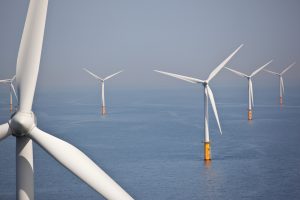
 A project to install the United States’ first offshore wind farm was recently completed off the coast of Rhode Island. An article in the New York Times describes the installation as the beginning of a new industry, which many people hope will someday make a large contribution to clean energy in the U.S.
What is the likelihood that it will? To be sure, wind power has obstacles to overcome before it can contribute a significant chunk of the clean energy mix in the U.S.
The intermittent nature of wind – even in the nation’s breeziest regions – means that utilities still require supplementing the lost generation when the wind isn’t blowing; that usually means tying wind power to carbon-burning natural gas-fired plants. And despite what appears to be an abundance of windswept locations across the U.S., we have already built wind farms in many of the locations where transmission of wind power is most economical. Without some significant breakthroughs in energy storage and massive investments in transmission, we don’t have a lot of room to grow the industry on land.
Optimism about offshore wind farms, particularly in the Northeast, stems from their potential to mitigate at least some of the concerns about wind power.
Ocean breezes tend to be steadier than those relied upon by turbines on land. And having miles of ocean floor to house turbines can increase capacity in a region that is characterized by dense populations and high energy demand. In the Atlantic, the coastal waters are shallow enough to allow many turbines to be built on the ocean floor rather than requiring more-expensive floating installations.
Resistance from residents near wind farm installations, who oppose the disruption to their view or the potential environmental impacts, has helped to sink offshore (and some land-based) wind projects before. For example, the large Cape Wind project – a plan to erect 130 wind turbines across 24 square miles in Nantucket Sound – encountered stiff opposition from homeowners who objected to the turbines marring their pristine views and fishermen who feared disruption to their livelihood.
The Block Island Wind Farm, on the other hand, is a tiny installation by comparison. Its size may have worked in its favor. The project comprises five wind turbines – with the capacity to power about 17,000 homes – three miles off the coast of Block Island. The Times article describes the location as a “rustic vacation spot,” where the project’s developers enjoy considerable local support.
Even when individual projects overcome these most common obstacles, the reality for wind energy overall is that the availability of raw material may pose limits to how much the industry can grow. Building a wind energy system takes almost 500 tons of steel and 1000 tons of concrete per MW of power, and that’s before the turbines are even connected to the grid.
The potential for offshore wind to contribute to our renewable energy mix is exciting. Once the turbines go online this fall, the Block Island Wind Farm will be a project to watch and learn from. However, as with onshore wind projects, there are practical limits to wind developments that likely will keep wind as a relatively small portion of our energy mix.
